Portraits of four researchers.

Research and Innovation Metrics

Each autumn, research universities around the nation quantify the value of their research enterprises by reporting on sponsored award funding (grants received from federal and state governments, corporate partners, foundations, and occasionally, private donors) and on their own research expenditures. These figures are important growth indicators, but metrics are only one method by which to measure the trajectory of university research. Here, we endeavor to share the stories of the people behind the research and innovation—and why their efforts are impactful beyond our campus—while including the metrics below.
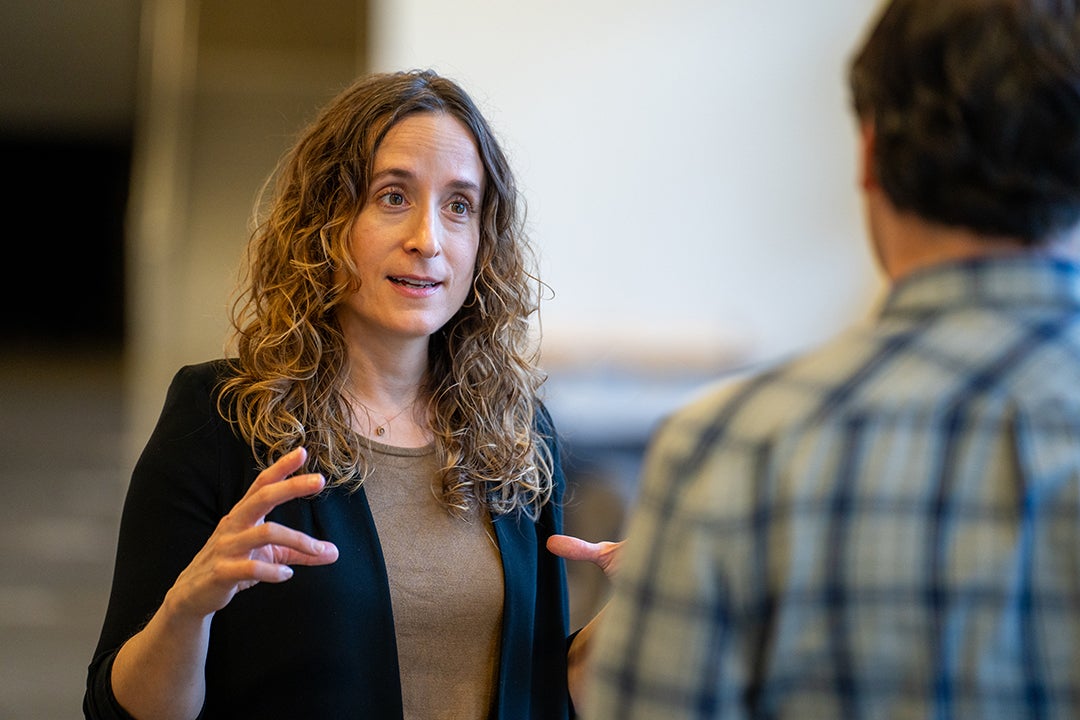
 

Woman speaking to a person with their back to the frame.
Investing in the Success of Early-Career Researchers Pays Dividends Later
Behind the vast majority of Eureka! moments are years of relentless effort. The same is true for successful research careers. At the University of Oregon, creating support structures and opportunities for early-career faculty are necessary to help those researchers build out their research with the goals of creating learning experiences for students, advancing discovery for the benefit of communities and humans broadly, and occasionally, spinning out intellectual property into patents, licenses, and companies.
In the past fiscal year, the UO has created important training opportunities for faculty applying for highly competitive research grants from the National Science Foundation (NSF) and the National Institutes of Health (NIH)—NSF Bootcamp and NIH Academy.
Additionally, three UO faculty—a volcanologist, a geophysicist, and a computer scientist—are participating in Fulbright exchanges this coming year to Iceland and Finland. Katie McLaughlin, executive director of the Ballmer Institute for Children’s Behavioral Health, and Lynn Stephen, professor of anthropology in the College of Arts and Sciences, join 15 other UO faculty as American Academy of Arts and Sciences members. Human physiologist John Halliwill was named a 2025 fellow by the American Association for the Advancement of Science for his work on how antihistamines and antiacids affect professional and casual athletes alike. Four faculty in chemistry and biochemistry—Andy Marcus, Michael Pluth, Teresa Rapp, and Dhiman Ray—were awarded NIH Maximizing Investigator’s Research Awards. Computer scientist Jieyang Chen won an NSF CAREER Award for his research on optimizing the training large language models.
Finally, the Week of Research and Innovation Celebration brought together faculty, staff, students, and postdocs to recognize excellence in research, scholarship, and discovery across every UO school and college. The weeklong celebration served as a welcome reminder that despite challenges and adversity, the research community is passionate, curious, and forward-thinking.
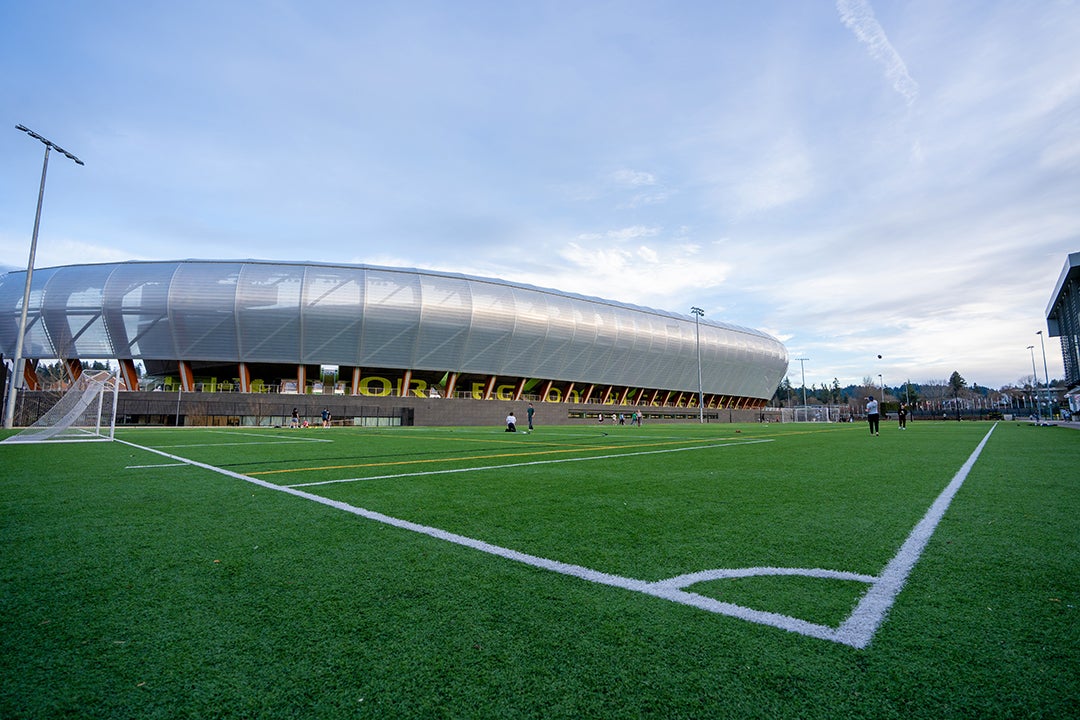
UO field with Hayward in the background.
Lifechanging, Skills-building Experiences for Undergraduates
Part of the undergraduate experience for many UO students is participating in research. These students gain crucial critical thinking and time management skills while fostering curiosity and building professional relationships with faculty and other students. Campus-wide, at the annual Undergraduate Research Symposium a record number of students presented on their research—597 presenters supported by 422 mentors.
Fourth-year media studies major and VPRI Undergraduate Fellowship recipient Elijah Jagne aspires to be a storyteller. 
“I think we are in a place, now more than ever, where it is important to get out there and document the world around us,” he said. “The more stories being told, and the more attention being directed toward important issues, the better.” 
For his fellowship project, Jagne turned his creative and investigative eye towards documentary filmmaking and found a scholarly home under the mentorship of Jesse Abdenour, associate professor in the School of Journalism and Communication. Together, they are producing a documentary about a group of young female rugby players and the scientists at the University of Otago—both in community of Dunedin, New Zealand—who are researching concussions and seeking to make the sport safer.
Jagne’s project uses documentary filmmaking as a research methodology, observing how young athletes, families, coaches, and scientists identify and respond to concussions over the course of a rugby season. While the scientists will use their findings to contribute new knowledge to concussion research, Jagne’s project has the goal of demystifying a complicated public health issue through film, a medium that can resonate with a wider audience. 
“Some studies indicate that traditional direct communication of concussion-safety protocols is not effective,” Jagne said. “Persuasion through narrative engagement could be an effective alternative method for transmitting concussion science and safety messages.” 
It’s a unique project that demonstrates the UO’s interdisciplinary strength in human performance and sport by merging documentary practice, storytelling, sports media, and health communication. 


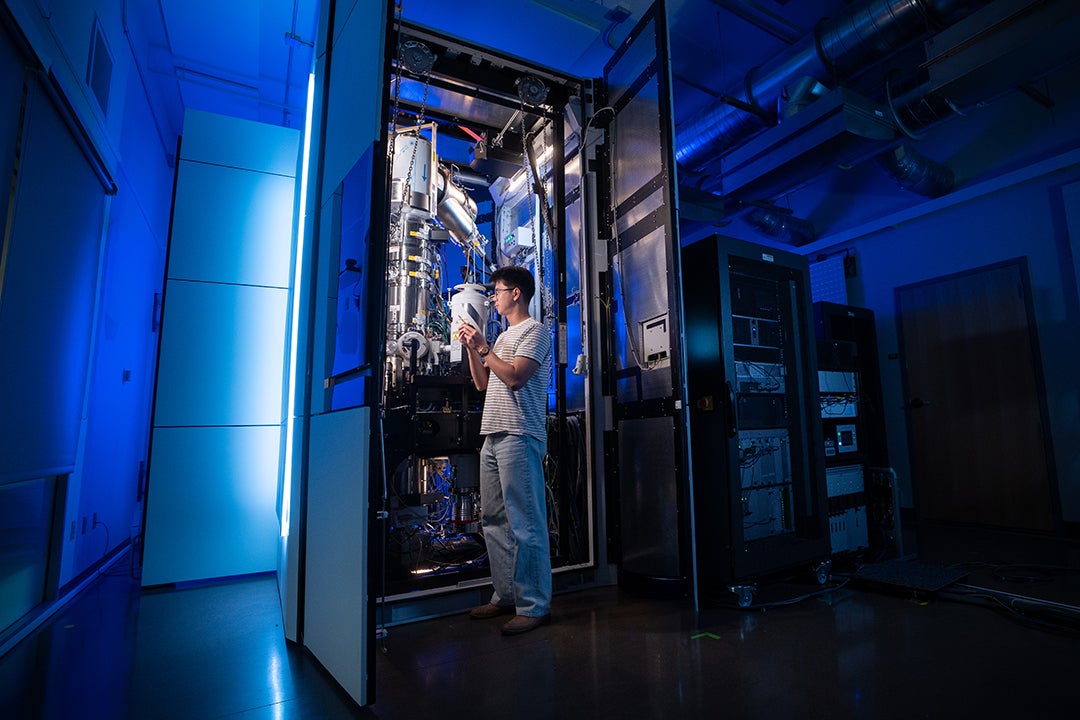
Man standing in front of the Transmission Electron Microscopy at the CAMCOR facility.
Collaborative Research Spaces
Our eight research core facilities provide researchers, industry partners, and students with access to the latest instrumentation and services. 
Highlights from fiscal year 2025-2026 include the acquisition of scanning transmission electron microscope that is alone in its class on the West Coast. Housed in the 35,000-foot Center for Advanced Materials Characterization in Oregon (CAMCOR), the microscope sees use for studies across disciplines, including biology, physics, and materials science. The microscope will play an important role in semiconductor research—the UO is a key partner in the National Science Foundation’s FAST Regional Innovation Engine, which aims to accelerate semiconductor research and workforce development.
In the Lewis Center for Neuroimaging (LCNI), professor of psychology and director of the Developmental Social Neuroscience Lab Jennifer Pfiefer wrapped up a groundbreaking 12-year longitudinal study about the transitions experienced by adolescent girls as they mature to adulthood. In that time, LCNI logged 754 scanning sessions on its MRI machines for 217 girls.
And finally, the newest UO core facility, the Oregon Acoustic Research Laboratory (OARL), is expected to come fully online in 2027. Responding to the regional and national need for more affordable housing, OARL will provide floor-to-ceiling testing chambers to study mass timber acoustic sound transmission (nobody likes a noisy neighbor). These new research and industry testing capacities will support increased utilization of mass-timber assemblies in low-, mid-, and high-rise housing and commercial buildings.
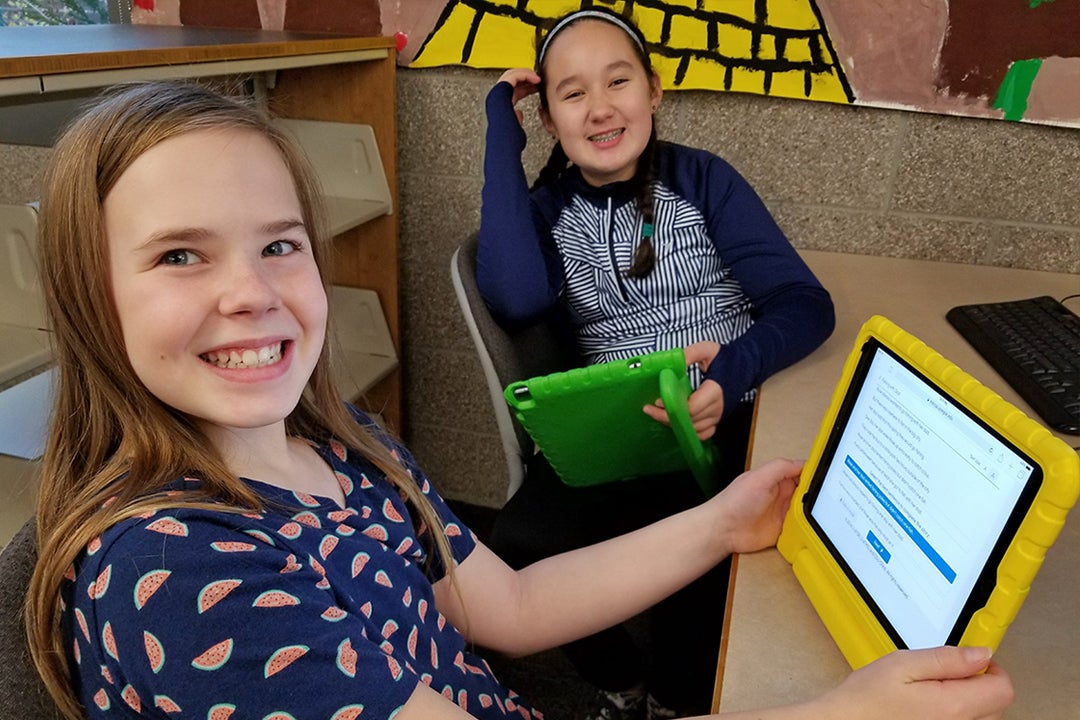
Two girls smiling with tablets in their hands.
Market-based Solutions Built on University Research
It’s easy in the innovation space to fall back on numbers—they’re catchy and easy to digest. And it’s true that the UO’s metrics are nothing to sniff at: The university’s innovations are licensed in 44 countries. One in four American schools use a product or service developed here. In fiscal year 2025-26, the UO saw $35 million in licensing revenue reinvested back into the research enterprise.
But a more complete picture of the innovation enterprise can be found in the stories of the individuals engaged in translating research into market-based solutions. Gina Biancarosa, the Ann Swindells Chair in Education and one of the researchers behind reading comprehension tool MOCCA, saw a need: Reading comprehension assessments tell teachers whether students understand what they’re reading or not, but not why a student might struggle with comprehension. MOCCA analyzes how students process information while reading, connecting ideas within a text.
Integral to scaling up MOCCA's reach and extending its functionality was a U.S. Small Business Administration Small Business Innovation Research (SBIR) grant that helped to fund improvements to the platform for teachers, including upgrades to usability and the web interface. The success of the program is a testament to the importance of award mechanisms like SBIR, which provide crucial early innovation funding to faculty researchers.

Back to Top


A Year in Numbers 

The University of Oregon’s research expenditures held steady in fiscal year 2025-26 (FY26) at $125 million. Sponsored project funding, which supports scholarship and creative activity across the university, increased slightly to $154 million in new awards—an indication of the resilience of the UO’s research enterprise in the face of changing federal priorities related to research, including fewer funding solicitations, increasing compliance requirements, and lengthy proposal review delays. We offer an interactive dashboard with insights into externally sponsored projects—proposals, awards, and expenditures—to users with a Duck ID. Please reach out to researchanalytics@uoregon.edu for more information. 


Sponsored activities cover research and creative activity, as well as instruction (e.g., new course or curriculum development) and service (e.g., programming and services provided by the university). FY26 sponsored project funding held steady from FY25.

The UO continued to further diversify its funding portfolio in FY26, with non-federal funding increasing from 17% to 39%. Non-federal sponsors include private foundations, non-profits, state contracts, and more. The major federal funders of UO sponsored activities are the National Institutes of Health (29%), the National Science Foundation (14%), and the US Department of Education (11%).


Sponsored activities cover research, as well as instruction (e.g., new course or curriculum development) and service (e.g., programming and services provided by the university). The UO’s unique research portfolio includes not only tenure-track faculty, but demonstrates immense strength among career research faculty, represented in the “Other” category, along with graduate students and postdoctoral scholars securing fellowships.

Research expenditures are a critical metric for R1 universities, reflecting an institution’s ability to secure funding, drive innovation, support faculty and student research, and contribute to economic and societal advancement. The UO's research expenditures remained largely steady in FY25 and FY26, a strong outcome given significant uncertainty across the federal research funding landscape.

Back to Top

Celebrating our 2026 achievements.

UO drives discoveries that benefit local, regional, and global communities.


380
grants awarded


61%
federally funded


$180.1M
sponsored expenditures

Investors and industry partners help bring UO innovations to the world.


11,023
total licenses


25
active startups


$8.1M
licensing revenue


Reports

Monthly Awards Reports

The Office of the Vice President for Research & Innovation (OVPRI) provides a monthly summary of funding awards and projects at the University of Oregon. Please note that the monthly award reports do not include recurring task orders on existing grants., non-competitive continuations, and other types of supplemental funding.

Sponsored Project Services Annual Reporting

Sponsored Project Services (SPS), a service unit within the Office of the Vice President for Research & Innovation (OVPRI), prepares an annual summary of sponsored activity at the University of Oregon.

Financial Reporting

The Business Affairs office at the University of Oregon provides a variety of financial statements and reports, including annual and quarterly financial reports for the University. Visit their financial reports page for more information.