
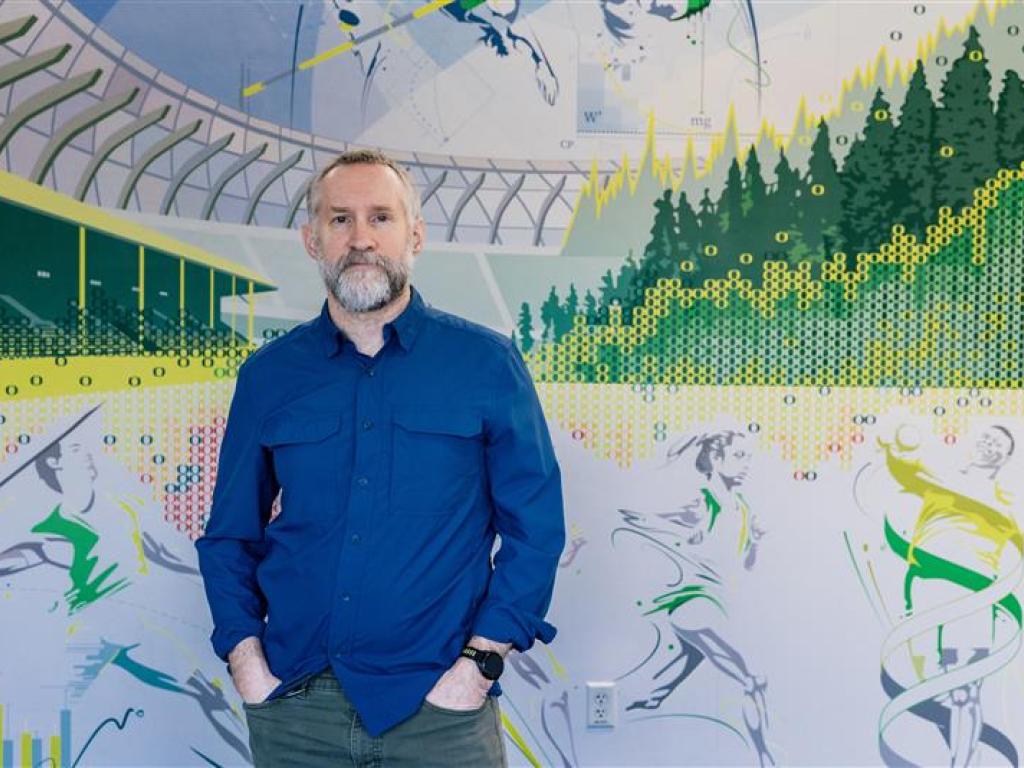
John Halliwill has been named a 2025 fellow by the American Association for the Advancement of Science (AAAS), along with a cohort of 500 scientists, engineers, and innovators spanning 24 scientific disciplines.
Halliwill is a professor in the Department of Human Physiology at the University of Oregon College of Arts and Sciences. AAAS awarded him the fellowship for his contributions to human physiology, particularly for advancing the understanding of exercise-induced cardiovascular adaptation and discovering histamine's role as a signaling molecule in adaptation to physical activity.
"Professor Halliwill’s research on how antihistamines and antiacids affect professional and casual athletes alike is an example of how important human performance research is, particularly in Track Town USA,” said Geri Richmond, interim vice president for research and innovation. “Additionally, John’s work has helped us further understand the positive effects of exercise on lowering blood pressure—an issue that affects many people, particularly as they age.”
Discovering the human limits
As a high school student, Halliwill’s interest in human physiology began with a wilderness first aid class. That interest became an obsession as he grew fascinated with how the body adjusts and adapts to extremes, whether that’s climbing to the summit of Mount Everest, navigating to the South Pole, or experiencing spaceflight.
“I wanted to have a career where I could do research and make discoveries related to how humans interact and respond to different challenges, whether physical stressors like exercise or environmental stressors,” Halliwill said. “A lot of us explore that on a personal level, such as the person who decides to train and run for their first 5k or to run the Eugene Marathon.”
Blood pressure is a biological factor that can lead to cardiovascular disease, stroke risk, and kidney damage if it’s too high for prolonged periods. What Halliwill was interested in solving was why athletes had low blood pressure — hypotension — after physical activity, sometimes to the point of lightheadedness and fainting.
Among Halliwill’s accomplishments that led to the AAAS fellowship award was his work on blood pressure and why athletes experience a drop after exercise. He was the first to find that the postexercise hypotension is a physiological response by the cardiovascular system, not a failure. This finding supported other studies that exercise can generate long-term benefits in hypertensive populations — those with high blood pressure.
Adapting to the allergy capital
At the UO, Halliwill co-directs the Exercise and Environmental Physiology Labs, launched the Evonuk Environmental Physiology Core, and co-founded the Bowerman Sports Science Center.
His research on postexercise hypotension hit a turning point 20 years ago, when his team discovered that the drop in blood pressure after exercise was due to histamine — a chemical released by the immune system when detecting and responding to perceived threats, such as allergens — being released during exercise. Since then, he and his research team have focused on histamine and exercise.
Studies led by Halliwill, and funded by the National Institutes of Health and the Wu Tsai Sports Human Performance Alliance at Oregon, suggest that antihistamine drugs can inhibit exercise performance and impair adaptation to exercise training. In his research, participants took a high dosage of antihistamines and antacids (both drugs block the effects of histamine) or a placebo. What Halliwill and his researchers found is important to athletes and patients alike, who exercise for health, fitness, or competition.
“The goal is to be able to provide more personalized advice to athletes, whether it's the recreationally active individual or the elite performance athlete who also deals with allergies,” Halliwill said. “How they should address their allergy problems so that it doesn't interfere with their training or performance.”
It’s a balance that applies to all, whether they’re performing on the world’s athletic stage or a local trail, while facing the stressors that come with exercise and allergies.
Mentoring the next generation
Throughout his career, Halliwill recognizes that he has succeeded because of the mentorship he has received, from high school sports to working as an undergrad in a lab. And he’s committed to mentoring the next generation of human physiologists and to providing some guidance as they develop their career paths.
To encourage the curiosity of discovery, Halliwill said he reminds his students that science doesn’t always end the way you think it will when the experiment is planned. Research posters in his lab often have a section with the heading “In Contrast to Our Hypothesis,” a statement that highlights his team’s efforts to prove themselves wrong. It is a way to remind students to purposefully seek to challenge their own hypotheses and to be open to the unexpected.
“We got really good at coming up with creative and interesting hypotheses and then proving them wrong,” Halliwill said. “That really moves science forward.”