
Through photos of their research and research processes, undergraduate students who participated in the third annual Research Revealed photo contest showcased the wide breadth of research at the University of Oregon and some of the many creative ways to demonstrate research visually.
This year, the contest was held earlier than in previous years so that winning entries could be displayed at the Science Communication Showcase, held April 7 as part of the Week of Research and Innovation celebration. Cosponsored by OVPRI, the School of Journalism and Communication, and the Institute for Resilient Organizations, Community, and the Environment, the event featured lightning round science communication presentations from faculty, staff, and students, as well as the announcement of this year’s Research Revealed winners. Those in attendance also selected a people’s choice winner. Thirteen undergraduate students from nine majors submitted entries, representing disciplines across the natural sciences, social sciences, humanities, and design.
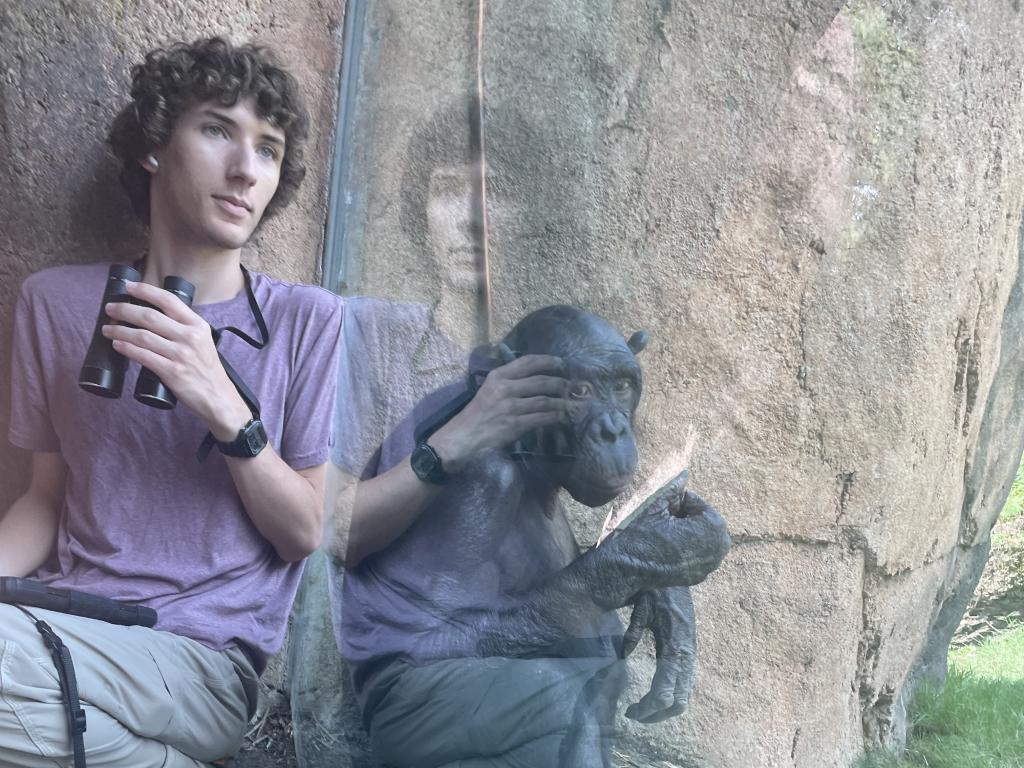
Sebastian Vagner, a biological anthropology major and fourth-year student, won first place and a $250 prize for his submission titled “Reflection of Humanity in a Bonobo.” The photo shows Vagner collecting observational data on bonobo behavior at the Columbus Zoo and Aquarium, where he spent the summer of 2025 observing animals nearly every day. As Vagner writes in his caption, one day while watching a distant group of bonobos, a 24-year-old male bonobo named Bila Isia walked up to the window and sat down beside him.
“As our closest living relatives, these apes offer a valuable glimpse into what it means to be human,” Vagner wrote in his photo caption. “It’s difficult to watch bonobos without feeling like I’m staring at a reflection of myself and my own humanity.”
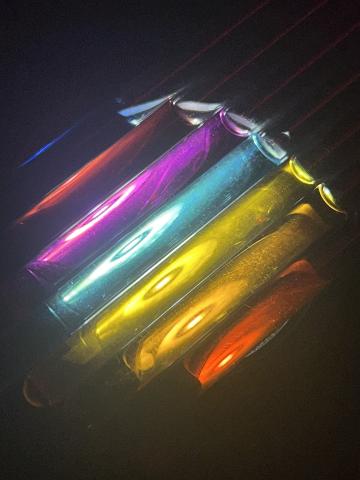
Second place and a $150 prize went to Natafira Suryanata, a third-year chemistry major, for the entry “The Color of Discovery.” Her photo features brilliantly colored NMR tubes holding ruthenium complexes, compounds being studied in the Rapp Lab for their potential to reduce the need for injections in drug delivery.
“Each hue reflects the unique properties of the compound,” Suryanata wrote, “and subtle shifts in their colors inform us of changes happening at the molecular level.”
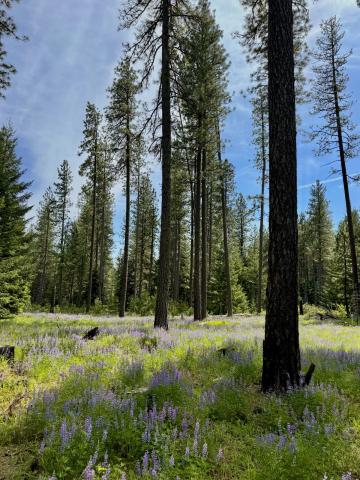
Third place and a $100 prize was awarded to Flora Booker, a fourth-year environmental studies major, for “Burning for Biodiversity.” Booker’s photo captures a ponderosa pine woodland where frequent prescribed burns encourage an abundance of fire following plants. Supported by a Vice President for Research and Innovation Fellowship, Booker works with the Mount Adams Resource Stewards Prescribed Burn Association. Her image highlights the dark burn scars at the base of fire adapted ponderosa pines and the lupines blooming at their feet. They are the seeds that survived the fire and sprouted in the enriched conditions that were left behind.
“This is my lab, where science meets stewardship,” Booker wrote.
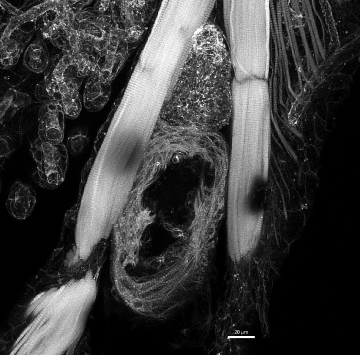
The people’s choice winner, selected by attendees at the Science Communication Showcase, was Sara Swinson, for her image “Guard Your Heart, a Lesson from Danio Rerio.” She received a $50 gift card.
Overall, this year’s submissions exemplify the creativity and curiosity that undergraduate researchers bring to their work across disciplines, from the chemistry lab to the library, and to the field.
To learn more about the many options for student research experiences, visit the Undergraduate Research Opportunity Program.