

Ideally, at the completion of their master’s or doctoral degree, newly minted graduates launch directly into successful careers rooted in their research interests. However, the ideal doesn’t always match reality, especially in a challenging economy.
The National Science Foundation Research Traineeship (NRT) program is a mechanism that serves to make it more likely that graduates land a job quickly after graduation. NRT targets graduate students pursuing careers in STEM fields (science, technology, engineering, and math). In particular, NRT grants enable institutions like the University of Oregon to provide training opportunities that are innovative, build in partnerships with public or private entities, and align with changing workforce needs.
“At many universities, graduate training is fairly standardized: Take classes, do research aligned with federal grants, get teaching experience,” said Pluth, professor of chemistry and biochemistry. “Many students don’t get the specific skills they need to go on to career paths they want to do. A training platform that connects with the strong base of education through research but is expanded to include skills training in professional collaboration and leadership, and exposure to career paths in industry and beyond—that’s a more evolved model of graduate education than, ‘Go figure out where you’re going from here.’”
Through the combined efforts of professors Vickie DeRose, Mike Pluth, and Darren Johnson—faculty in the Department of Chemistry and Biochemistry and members of the Materials Science Institute—the UO’s “NRT-URoL: Molecular Probes and Sensors for Complex Environments” program has exceeded expectations.
Awarded in 2020, the five-year grant (which was extended, at no cost to the National Science Foundation, for an additional year), has funded 38 UO graduate students from six academic disciplines, laid the groundwork for a scientific partnership with Thermo Fisher Scientific, a biotech instrumentation and services company, enabled the creation of the “Lens of the Market” professional and entrepreneurial development program, and has served as a launchpad for a student-led materials science startup, AlChemy Coatings, to take its first steps toward incorporation.
R&D Collaboration with Thermo Fisher Scientific Leads to RNA-detecting Dye
Graduate and doctoral degrees focus on research and industry experience more heavily than the average undergraduate degree. Faculty and staff at the UO have over time built relationships with the Thermo Fisher Scientific site located in west Eugene, which have led to lowering barriers to collaboration.
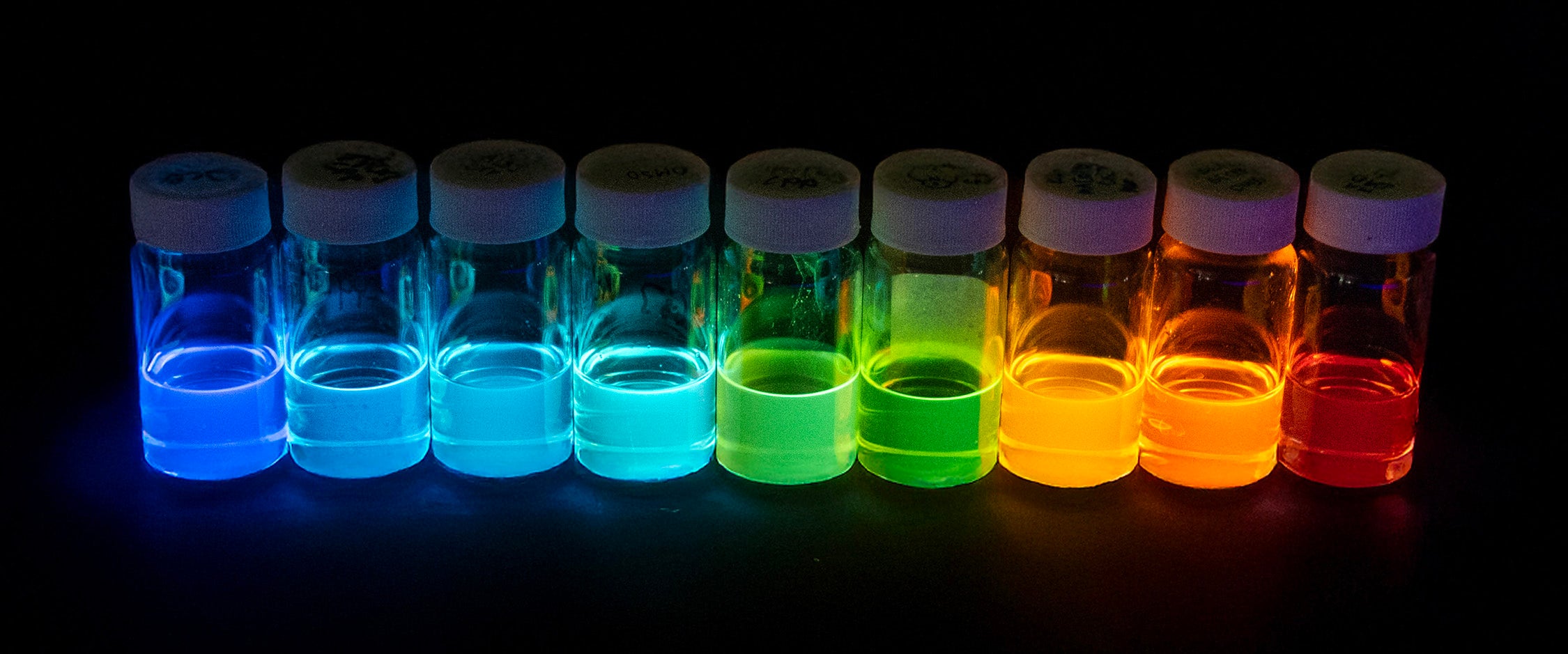
A result of these efforts is a brand-new product on the market for life sciences researchers: An RNA-selective red-emitting dye. Used in cell imaging, the dye helps scientists isolate RNA in cells from DNA and proteins.
Katelyn Alley, who just graduated with her doctorate in chemistry and biochemistry and who also served as the NRT student coordinator during her time in the program, played an integral role in the dye’s development by applying it as an end user to demonstrate the dye’s potential and usefulness. “This had a hugely beneficial impact on my career, and it was amazing to get to work hands-on with a staff scientist at Thermo,” Alley said. “I had the chance to see what R&D and innovation looks like in industry. The collaboration gave me the ability to work on the questions I was interested in for my doctoral thesis while also answering a question they had.”
In addition to working on the collaborative dye development project, Alley invited various Thermo Fisher scientists to the UO to give career talks to her fellow students.
“This collaboration wouldn’t have started if we didn’t have the NRT grant-driven collisions,” said Vickie DeRose, chemistry and biochemistry department head. “NRT provided a focal point for our interactions. We really benefited from the scientific knowledge of Thermo Fisher’s staff that we aren’t normally exposed to.”
Building an Entrepreneurial Mindset
“Helping students to get beyond viewing the research as the end itself, so they can identify the uses of their conclusions beyond an academic paper is useful for students’ future job activities. We’re training them to think in terms of what specific problems need solving,” Pluth said.
One such problem is a prevalent one: For decades, per- and polyfluoroalkyl substances (PFAS) have been used in coatings to waterproof textiles and paper. Also known as “forever chemicals,” PFAS are now known to disrupt human endocrine systems (those that create hormones) and cause widespread environmental contamination.
An NRT grant participant, Alex Rosen, started a company during his doctoral program to address the issue of PFAS contamination head on. AlChemy Coatings uses a sapphire coating made from aluminum oxide to create a UV-resistant, water-repellant, and scratch-resistant coating to serve as a PFAS-free alternative for weatherproofing clothing, paper, and many other consumer products.
AlChemy received a National Science Foundation Small Business Technology Transfer (STTR) award in 2025, which, together with a Business Oregon matching grant, allowed the startup to incorporate. Rosen is in the process of applying for an STTR phase 2 award and plans to open a pre-seed round of private funding this year.
Outcomes
Studying Kilauea as it erupts. Attending a workshop to gain expertise in handling metals and proteins. Developing specialized microscopy skills. These are a few of the tailored opportunities the NRT grant has provided to students.
38: Graduate students supported
6: Participating departments (chemistry and biochemistry, biology, physics, bioengineering, earth sciences, and marine biology)
25+: Academic papers citing grant support
148: Students who completed Lens of the Market Stage 1. Eighty-two continued to the Stage 2 program, and two completed Stage 3 by founding AlChemy Coatings.
“At the trainee level, the NRT grants provides a space to create a community you wouldn’t normally find in grad school,” Alley said. “It fosters interdisciplinary research by establishing connections between the various degree programs. It sparks conversations and interactions you wouldn’t otherwise experience.”