
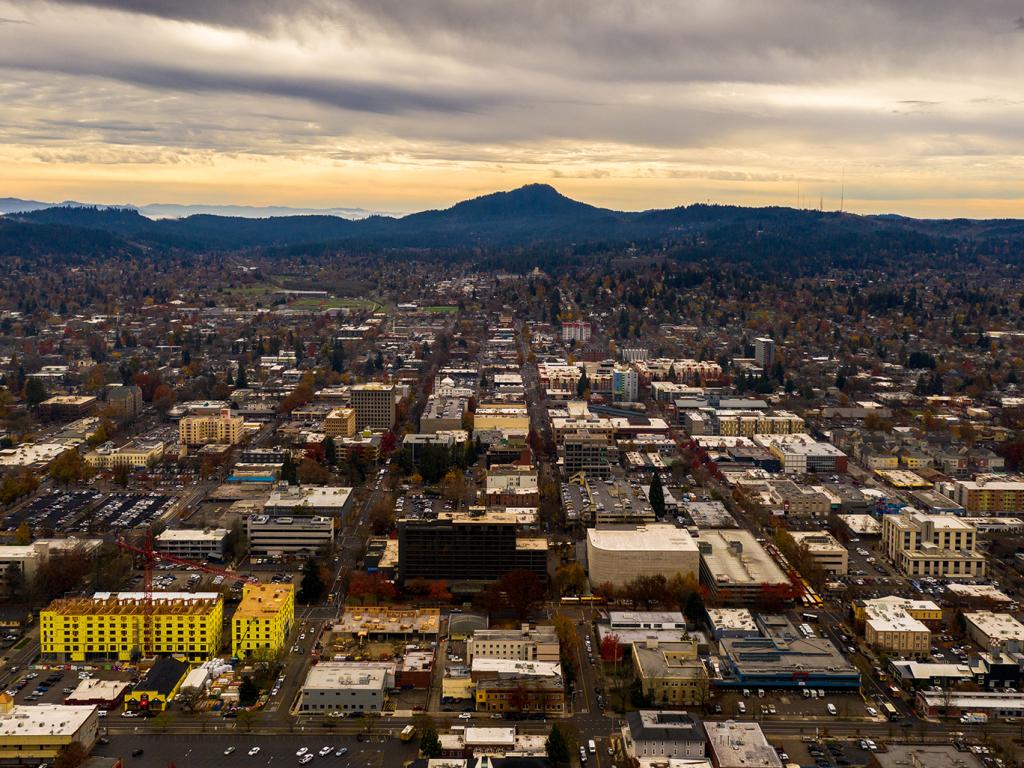
University of Oregon sociologist Claire Herbert studies the everyday realities of people living without formal shelter—those staying in cars, tents, abandoned buildings, and public spaces. Her upcoming book, When Home Is Illegal: Unsheltered Homelessness in America, takes a close look at how communities like Eugene are dealing with rising unsheltered homelessness and its complexities
A Growing Crisis
Unsheltered homelessness, defined as living in places not meant for human habitation—such as tents, cars, makeshift structures, or outdoor public spaces—has always existed, Herbert said, but in recent years has increased dramatically. By contrast, sheltered homelessness refers to people staying in temporary accommodations like emergency shelters or transitional housing designed to offer short-term safety and services. In Eugene, rates of unsheltered homelessness hover between 60–68% of all homelessness in the area, far higher than in many other cities but on par with others, especially on the West Coast, according to Herbert. This level of visibility shapes how communities experience the problem, how they respond to it, and how it becomes defined as a community issue.
Before coming to the UO, Herbert studied housing issues in Detroit and Philadelphia, where abandoned properties often serve as makeshift homes. In those cities, homelessness is often more hidden from public view, different from unsheltered homelessness in places like Eugene. Here, there is nowhere to retreat. People are constantly in shared spaces because they have no alternative, and being homeless in such public spaces fundamentally changes the dynamics.
The Community's Role
Those dynamics are the center of Herbert’s book, which Herbert became interested in while studying informal housing in Detroit, showing her how deeply people’s lives are shaped by access to stable shelter. For her upcoming book, she and her team conducted interviews with people experiencing unsheltered homelessness, housed residents, and a wide range of city and county employees—from police officers and park staff to city planners and public works crews whose jobs intersect with homelessness daily. Many of these workers, Herbert noted, “never expected to work with the social problems of homelessness and are now doing work that involves homelessness every day.”
Her findings reveal that unsheltered homelessness is not just about the absence of housing, but that the daily interactions and decisions of community members shape it. The problem is one created and reinforced by the ways housed neighbors, authorities, and people experiencing homelessness interact with one another.
Housed residents often call authorities when they see encampments nearby. Many express compassion for the people experiencing homelessness, but also concern for trash scattered around, human waste, or safety issues. Authorities respond because they are asked to, but the result is often a “move-along” order that forces people living outside to relocate with little notice.
These moving orders unintentionally undermine long-term solutions. When someone is displaced, they can lose essential belongings, relationships, and contact with outreach workers.
“It is harder for folks to stabilize and exit homelessness when they’re constantly moved around,” Herbert said. “When housed residents call the police or call parks authorities, they often have to respond, even if they know it is not a problem they can solve.”
The Labor of Survival
Herbert’s research also highlights the labor required to survive without shelter. The book’s first chapter walks readers through the exhausting tasks that fill each day: securing a place to sleep, finding bathrooms or showers, and washing clothes. These details, Herbert said, “take an immense amount of exhausting physical work, especially because people without shelter don’t even have a regular place to return to at night,” which can make it even harder for people to pursue employment, healthcare, or housing programs.
While her book examines regulatory systems and community tensions, Herbert is clear that the foundation of the problem is a shortage of affordable housing. She hopes that the project encourages readers to think about both structural forces and individual choices that affect housing availability. She emphasizes that these structural forces—such as stagnant wages, rising rents, and disinvestment in social services—set the conditions that make homelessness more likely in the first place.
At the same time, Herbert notes that everyday decisions made across communities can cumulatively influence housing availability. Choices related to land use, development patterns, and housing supply all play a part in shaping who can access stable, affordable homes. She stresses that this is not about blaming any particular group but about recognizing that “the decisions we make as individuals can play a role in perpetuating the problem.” “I hope we can all have a level of self-reflection about the small ways in which we could be making the problem worse rather than supporting a broad effort to alleviate it," said Herbert.
Ultimately, Herbert views her work as a form of translation. By amplifying the experiences of people experiencing homelessness, housed neighbors, and public workers, she aims to make their perspectives more legible to one another and to policymakers.
“Whether or not in their daily lives they’re doing something that’s productive or harmful for the problem, people still care about it,” Herbert said. “My goal is to bring it to the surface and make it accessible to other people who are in a position to do something about it more than unhoused people or neighbors.”
Herbert hopes her book gives policymakers and community members a clearer view of why unsheltered homelessness persists, not just that it exists. By bringing together the perspectives of unhoused people, neighbors, and authorities, her research surfaces the often-invisible dynamics that shape the daily lives of people experiencing homelessness. When Home Is Illegal: Unsheltered Homelessness in America aims to shift the conversation from managing homelessness in the moment to understanding its roots and creating conditions that support long-term stability.