


Editor's note: This article was produced by a student participating in the course J473: Strategic Science Communication, a collaboration between the School of Journalism and Communication’s Science Communication Minor program and the Research Communications unit in the Office of the Vice President for Research and Innovation.
Looking for Scott Fisher? You can reach him at his cosmic address from his introductory astronomy course.
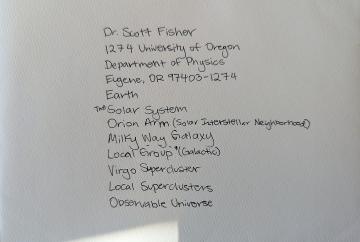
What is a cosmic address? It's the area where Earth is located in the universe. A means of interpreting our position within the vast expanse of space.
Fisher, director of the Pine Mountain Observatory (PMO) at the University of Oregon, has been on a years-long journey to make science accessible to anyone interested in astronomy. Leading with an enthusiastic approach, he engages students in the inner workings of our solar system and encourages curiosity to explore beyond their initial foundational development.
His mission to share his excitement for science at multiple scales has been cultivated through his intensive undergraduate research programs, creating and enabling outreach efforts at multiple observatories, and providing opportunities in the classroom to collaborate on work with NASA missions.
Prior to making the leap into academia, Fisher was an instrument scientist specializing in mid-infrared instruments at Gemini Observatory, doing work in Hilo, Hawaii and La Serena, Chile. During his final year of graduate school, Fisher had a unique chance to take on a project developing a camera named OSCIR. Alongside two other associates and his thesis advisor, they developed a specialized infrared camera—at the time one of two of its kind in the world.
“In my undergrad years and through grad school I was deeply immersed in the lab and worked primarily on that small team that built and used OSCIR on telescopes all over the globe.” Fisher said, “It was at the very end of grad school that I started to realize I like communicating science and that I had a knack for it. When I got to Gemini that was when I really had the first opportunity to develop those skills.”
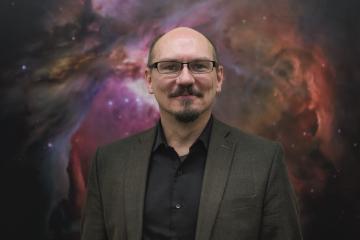
During his mid-infrared studies that delved into searching and researching planet-forming disks around young stars, Fisher also became a valuable outreach asset for the observatory. His knowledge and interpersonal skills led to him serving as the only outreach scientist for the Gemini Observatory.
In 2009, the National Science Foundation (NSF) appointed Fisher as the program officer in the Division of Astronomical Sciences, where he oversaw the Educational and Special Projects portfolio. There he specialized in overseeing grants for summer research programs, student development, and faculty startup funds to kickstart their research programs. Over a three-year stretch, he oversaw and allocated around $45 million worth of funding.
While making the journey back to Hilo in 2012 after his time at NSF, Fisher heard about an opening at the University of Oregon. From his constant practice of outreach at Gemini Observatory, it clicked for Fisher that he could create a more lasting impact by putting his science communication skills to use for student audiences. Soon he had landed in Eugene ready to take on the role of director of undergraduate studies in the UO's Department of Physics.
First Lights
Fisher added the directorship of UO's eastern Oregon-based observatory to his portfolio in 2015.
His work with students quickly developed into work that not only focused not only on astronomy but science communication.
“The first generation of students I worked with came up with the idea of the ‘Fisher Group’,” he said, “It’s a research group, but there’s a strong science communication component to this, and I’m very open with anyone who has interest in the group that if you want to join us, you will have to speak to the public and give talks in front of clubs sometimes or maybe we’re going to go to an elementary school.”
Fisher continued to say, “In my heart, I just feel that we’re in desperate need of folks who can communicate science appropriately.”
During his first few years at PMO, Fisher worked with various undergrads to build the newest telescope housed there: The Robbins. Named after generous donor Ken Robbins, the telescope is used for most of the undergraduate research that takes place at PMO.
In 2015, the first batch of students on the ‘Fisher Group’ put the initial hardware pieces on the Robbins. However, it was groups that followed that carried out a process known as integration, putting the hardware pieces together to make them communicate with one another. Followed then by commissioning, a process within the first six months of understanding the inner workings and capabilities of the telescope, and one Fisher describes as “a shakedown cruise” of how to use the Robbins itself.
The Robbins had its “first light”, the first moment the telescope was opened to see the sky, during the summer of 2016, a proud moment for Fisher.
These days, in collaboration with NASA's Transiting Exoplanet Survey Satellite (TESS) mission, Fisher and groups of undergraduate students scope out to confirm potential exoplanets with The Robbins.
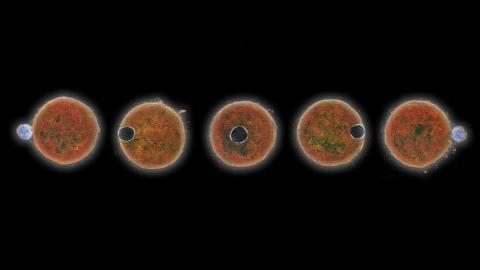
TESS maps out stars with potential exoplanets and sends that information to various observatories across the world, including PMO. Individuals at observatories are then left to observe the batches of stars for potential exoplanets. Through his work at PMO, Fisher and undergraduate researchers have detected around 15 exoplanets.
This primarily is done through capturing photos of the star and measuring its brightness. This process, known as the “Transit Method,” is a light curve analysis that detects small changes in the star’s brightness as the exoplanet crosses it. If the dip in the brightness curve of the star is significant enough, an exoplanet will be detected. In this way our own Pine Mountain is contributing to cutting-edge astronomy research right here at the UO and in Oregon.
“Something that stuck with me from a course survey I received a few terms ago was when I had a student say: 'The first day or two of class I thought it was a joke, I couldn’t believe it was so simple. But three weeks in I finally realized what Fisher was trying to do and that was he was shoving astronomy knowledge down my brain and I didn’t even know it,'" Fisher said. “That really stuck with me, I like that idea of let’s teach y’all some fundamental astronomy, but more importantly let’s make you not hate science.”