
Yvette Cendes, who also happens to be one of Reddit’s most popular astronomers, joined the University of Oregon’s physics department last year. Her Reddit page, Andromeda321, has more than 4 million karma points and over 25,000 followers—making her a top contributor on the platform. Known for her “Astronomer here!” posts, Cendes’s page shares exciting research-related news, gives advice to prospective astronomers, and more.
Cendes’ posts to Reddit are just one of the ways she engages with the public to spread a love of astronomy and a passion for learning. Cendes strives to make astronomy and physics more accessible to everyone, and her work has been featured in Astronomy Magazine, Discover, and Scientific American.
“I’ve always felt it was very important to share with the public, who are ultimately paying for a lot of this,” said Cendes. She says that as she loves astronomy, it is important to her to share that love with other people. “I think when you’re in love with something, you want to shout it from the rooftops.”
Along with her science writing, Cendes is also the astronomy consultant for the Guinness Book of World Records. Given her interest in storytelling and outreach, it is no surprise that a book on astronomy influenced a 13-year-old Cendes to fall in love with astronomy.
“I wanted to be an astronomer because I love stories, and the story of the universe is the biggest one we have,” she said.
Now at the UO, Cendes is a member of the Institute for Fundamental Science, continuing her radio astronomy research, helping further develop a proposed astronomy program, and supporting new voices in the field. Natalie Velez, a PhD candidate working in Cendes’s lab, joined the lab during maternity leave, which she says is unconventional, but worked out because of Cendes’s leadership.
“She made the transition feel seamless and helped me get up to speed quickly on both the science and the resources we use,” said Velez.
Studying the celestial through radio waves
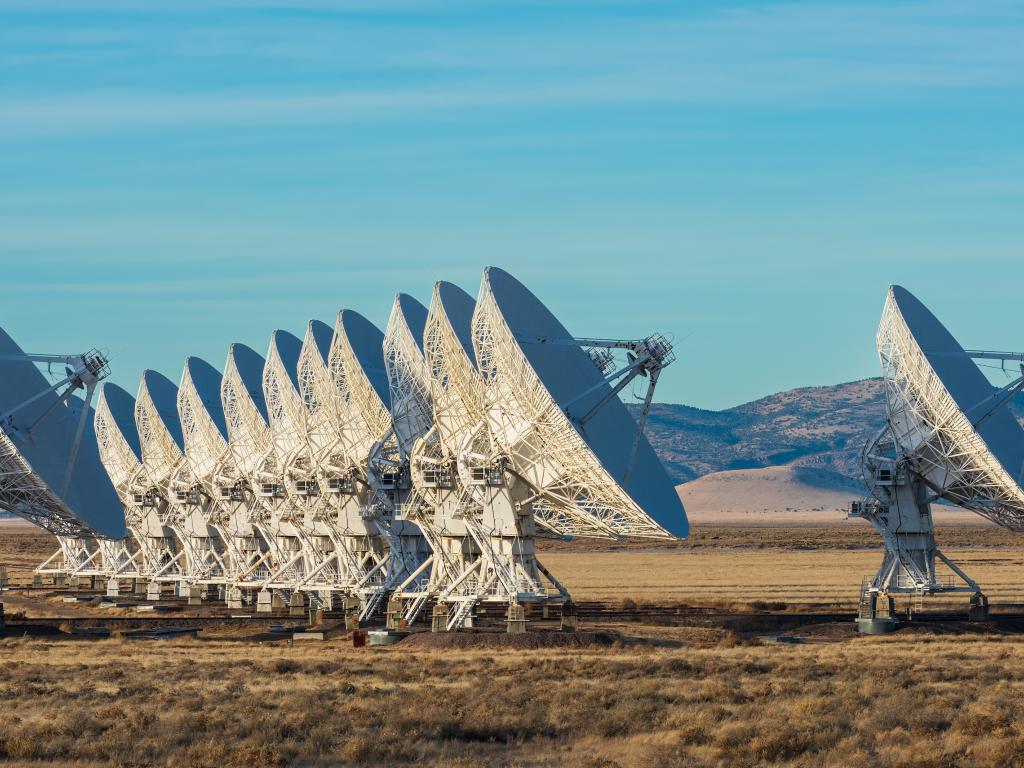
Radio astronomers use telescopes that measure the energy of the radio frequencies an object in space emits. Cendes uses data from the Very Large Array (VLA) in New Mexico to investigate tidal disruption events (TDEs), which occurs when a star drifts too close to a black hole and is shredded by the tidal forces—the difference in the strength of gravity between two points—around the black hole. When a black hole shreds a star, an outflow of material from the cosmic event emits radio waves. Cendes has found that in around 40% of cases, there is some sort of outflow into the surrounding material even years after the initial TDE. This is an increase from the 20–30% of cases in which astronomers can see outflow several months after the event.
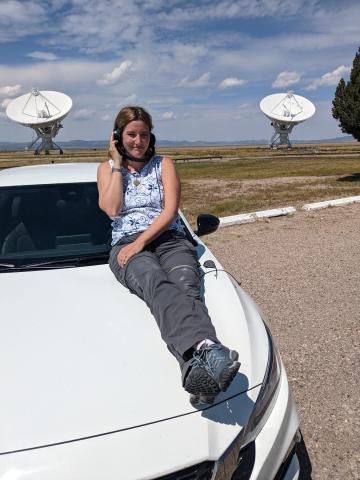
In 2021, Cendes discovered new radio emission from a TDE, AT2018hyz, that she nicknamed “Jetty McJetface.” The TDE was first discovered in 2018 at a distance of 665 million light years from Earth, but no radio emission was detected from this source until Cendes spotted it rapidly rising in emission at all radio frequencies, which it has continued doing ever since. As of summer 2025, Jetty is now over 40 times brighter in radio than when it was first detected—making it one of the brightest TDEs in radio.
“It is emitting an estimated energy equivalent to more than a trillion times that of the Death Star in Star Wars. No one is quite sure why,” Cendes said.
Cendes says there are a number of potential reasons that a TDE would become brighter in radio so long after the initial event. Some scientists think there might have been a density change, a second outflow, or there might be jets that make the TDE visible using radio. Cendes says 1% of TDEs release a beamed shockwave, or jet, that moves at almost the speed of light. All the observed jetted TDEs to date have coincidentally been pointed “pretty much directly at Earth,” enabling our telescopes to intercept the radio waves.
“You can imagine that if we know there’s some pointed directly at Earth, there should be some that are 45 degrees to Earth, and then later, over time, you’re going to start seeing that emission as it enters our line of sight,” she said.
Research on Jetty is still ongoing, as the radio emission has yet to peak. However, Cendes says it is unlikely that there is only one explanation for why these TDEs are emitting frequencies where astronomers previously detected nothing. And that’s part of the fun: Unraveling the mysteries behind these events.
Expanding astronomy’s presence at the UO
As Cendes continues her work on Jetty and other TDEs, she is also working to expand and improve the astronomy department at the UO. Cendes, along with other faculty, is working to bring an astronomy degree program to the UO.
Cendes plans to offer a three-course astrophysics sequence, with one class covering stars, another on galaxies and cosmology, and the third on planets and exoplanets (those outside our solar system). As of this writing, Cendes is hoping that an astronomy minor will debut this fall.
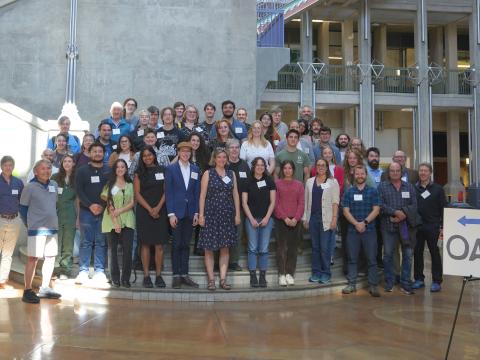
Along with new courses, Cendes is connecting students to real-life experiences in astronomy and with astronomers. She is hopeful that one of the new courses will feature visits to the UO’s Pine Mountain Observatory east of Bend, Oregon, to give students experience using a telescope and processing data. She also spun up the first-ever Oregon Astronomy Research Symposium (OARS), which debuted September 2025. She hopes OARS will serve a valuable venue for new and experienced astronomers alike to connect, share ideas, and collaborate.
“I’m very excited for OARS, as astronomy research in Oregon is a relatively small community, so it’ll be great to have an event that brings everyone together,” PhD candidate Velez said. “I anticipate it will be a great networking opportunity, especially for astronomy students.”