
Perception is not a spectator sport—the notion that the outside world is happening to us is an illusion. Sensing is an active process: Eyes move constantly to construct vision, fingers must touch to feel texture, and we only smell molecules we actively inhale. Much of what we know about sensory perception emerged from highly controlled experiments. Many neuroscientists avoid studying behavior involved in active sensing because of methodological difficulties.
Researchers in the Institute of Neuroscience are taking on this challenge. The lab of Emily Sylwestrak, assistant professor of biology and neuroscience, studies how surprises and disappointments teach mice to strategize foraging. Mike Wehr, professor of neuroscience and psychology, and Cris Niell, professor of biology and neuroscience, study how mice use hearing and sight to guide natural behaviors like capturing prey, jumping, and foraging. By focusing on the rich diversity of natural behavior, they're giving us a new understanding of how the brain functions under natural conditions.
To better understand how brains sample the world, scientists study how mice explore the world with their noses in the labs of James Murray, assistant professor of biology, mathematics, and neuroscience, and Matt Smear, associate professor of neuroscience and psychology. They record neuronal activity in the olfactory bulb, the first brain region that receives odor information, in mice moving and sniffing freely. By treating the rhythms of natural sniffing as behavioral structure, they found that the olfactory bulb does more than process smells. It also tracks breathing rhythm and location information for each inhalation.
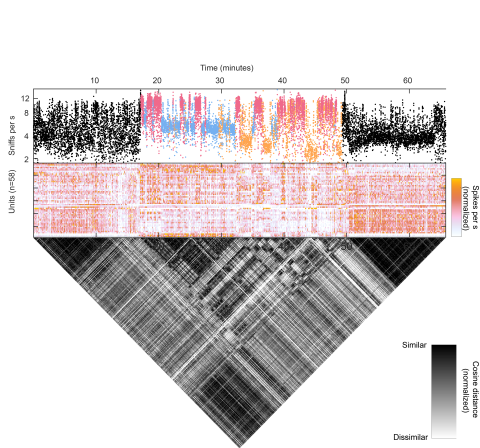
These findings help us understand how breathwork practices impact brain function and may inform treatments for smell loss associated with COVID-19 and neurodegenerative diseases.
Recording brains during natural behavior generates complex data that requires new strategies and computational tools to analyze. Smear and doctoral candidate Leah Blankenship developed a tool for converting data to sound, called Visualizing and Sonifying NeuroData (ViSoND). By synchronizing the sound with video, researchers can hear breathing rhythms and brain activity while watching behavior unfold. This approach was essential for Smear's discovery about how the brain pairs breathing rhythms with behavioral states. By adding sound to sight, ViSoND lets researchers perceive patterns that visualization alone cannot show.
Revealing hidden structures within Smear’s large sniff-behavioral datasets requires expertise in physics and mathematics. Theoretical neuroscientists in the Murray lab built new computational tools that defined the rich rhythmic structure of mouse sniffing while in the lab of Luca Mazzucato, associate professor of biology, mathematics, and neuroscience, researchers designed new strategies for modeling how animals structure their behaviors across multiple timescales. These sophisticated computational analyses have also inspired new directions in artificial intelligence.
Standard AI systems are built as passive spectators that receive data according to fixed rules and produce single solutions. In contrast, biological intelligence actively chooses what to sample, preserves variation, and adapts to different contexts. Postdoctoral fellow in the Niell Lab Ifedayo-Emmanuel Adeyefa-Olasupo is building AI systems that preserve and leverage diversity like biological brains do. These efforts will help deliver artificial agents that are more adaptive and resilient.
Sensation and behavior are linked by the active mind. By designing experiments that collect and scrutinize variability in naturally recorded data sets, researchers at the UO are revealing ways that behavior instructs an animal’s perception just as much as sense guides how an animal will respond. The challenge of generating and analyzing these complex data is generating new advancements in technology and AI.