
Darren Johnson has been elected as a fellow of the National Academy of Inventors (NAI). Previously a senior member of the organization, he joins seven other UO faculty fellows, including Nobel laureate David Wineland, in earning the highest professional distinction paid to academic innovators. This year’s class of NAI fellows include 169 scientists from 127 institutions.
“This recognition is really meaningful to me,” Johnson said. “Innovation activities have been important to me in my time at Oregon. I started at a time when the UO encouraged its faculty to participate in innovation, but that wasn’t a national trend. Now we’re in a place where most of our students and all of our new faculty in chemistry and materials science are interested in innovation. It’s exciting to see how far we’ve come.”
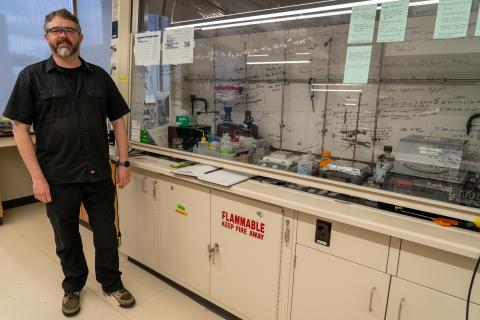
Johnson joined the University of Oregon in 2003 and currently serves as associate vice president for research with the Office for the Vice President for Research and Innovation and is the Lorry Lokey Chair in the Department of Chemistry and Biochemistry. His research uses supramolecular chemistry—the study of how molecules interact without forming permanent bonds—to address critical environmental challenges, such as the detection and removal of toxic metals and nutrients from water systems. His innovations contribute to cleaner water, sustainable agriculture, and reducing the need for forever chemicals in water-proof coatings.
Patents Help Farmers, Resource Managers Maintain Soil and Water Quality
He is the lead inventor or co-inventor on patents covering a wide range of technologies. These include nitrate sensors for precision agriculture, which led to the founding of SupraSensor Technologies, a UO spinout company later acquired by The Climate Corporation. The sensors help farmers determine nitrate levels in their soil.
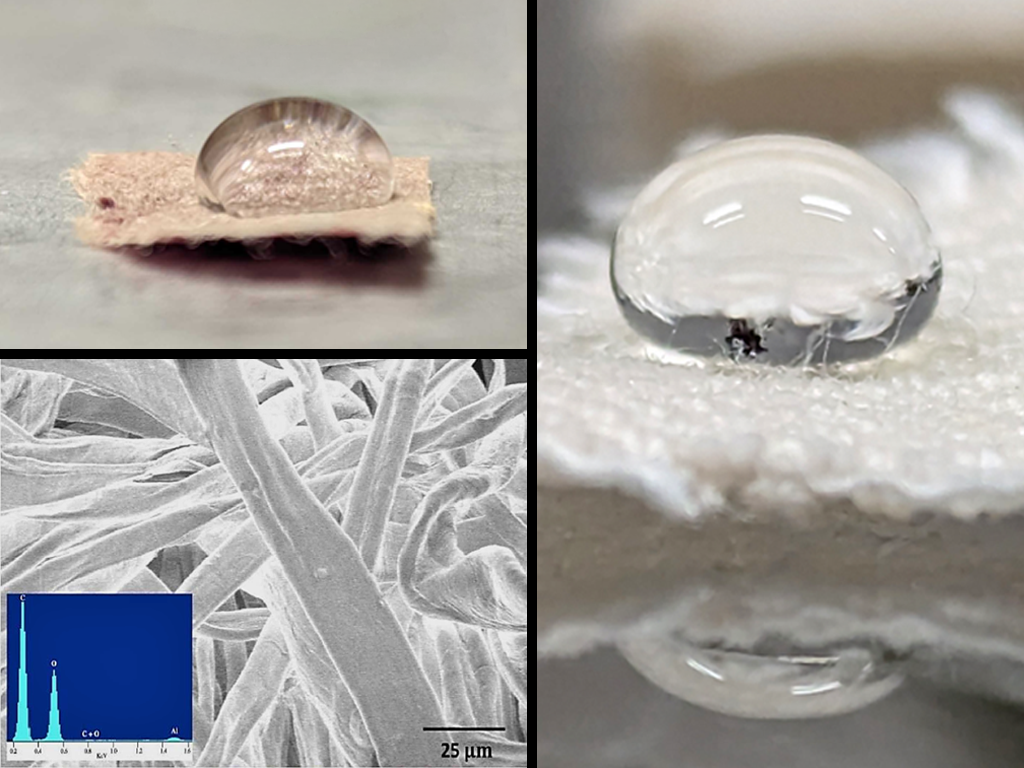
The latest research stemming from these nanoscale clusters has led to methods under development to avoid the use of harmful per- and polyfluoroalkyl substances (PFAS) in coatings for textiles and paper.
From the discovery of these coatings has been born a new spinout company, AlChemy Coatings, which uses a sapphire coating made from aluminum oxide to create a UV-resistant, water-repellant, and scratch-resistant coating that could serve as a PFAS-free alternative for weatherproofing clothing, paper, and many other consumer products. Since receiving an NSF Small Business Technology Transfer (STTR) award, AlChemy has incorporated and plans to open a pre-seed round of funding in 2026.
“A really eye-opening part of getting involved in innovation as realizing there’s an innovation cycle,” Johnson said. “Fundamental science feeds applications and innovation, but those innovations themselves drive basic science questions. And for our students, participating in the innovation pipeline can be the most direct way for them to have an impact on society. These startups and professional development opportunities launch their careers and change the world.”
The Innovation Cycle
Johnson’s patents (he holds 17 of them) reflect a strong emphasis on translational science, with several licensed or under active development for commercialization. His work has attracted more than $4 million in commercialization and innovation funding from federal agencies and corporate sponsors such as the National Science Foundation (NSF) via grants and participation in the I-Corps program.
As a Senior Member of the NAI, Dr. Johnson actively contributed to the Academy’s mission. His mentorship of students and postdocs, many of whom have gone on to impactful careers in academia and industry, reflects his commitment to cultivating the next generation of inventors. He co-launched the molecular sensors and biotechnology track in the Knight Campus Graduate Internship Program, which places students in leading research institutions and companies.
“It’s important for our science students to see innovation activities during their Ph.D., to take part in the patent process where appropriate, to do internships at national labs, to think about their research through a different lens—what the market may need—and in some cases start a business out of their research,” Johnson said. “Being named an NAI fellow is nice validation that those efforts have meaning, but I’ve known for years the impact of student training experiences, like Lens of the Market. It’s a great feeling when a former student writes me an email telling me that their Lens of the Market or internship experience got them their new job.”
Johnson was named a fellow of the American Association for the Advancement of Science in 2024.
Read about last year's three UO inductees to the National Academy of Inventors.