
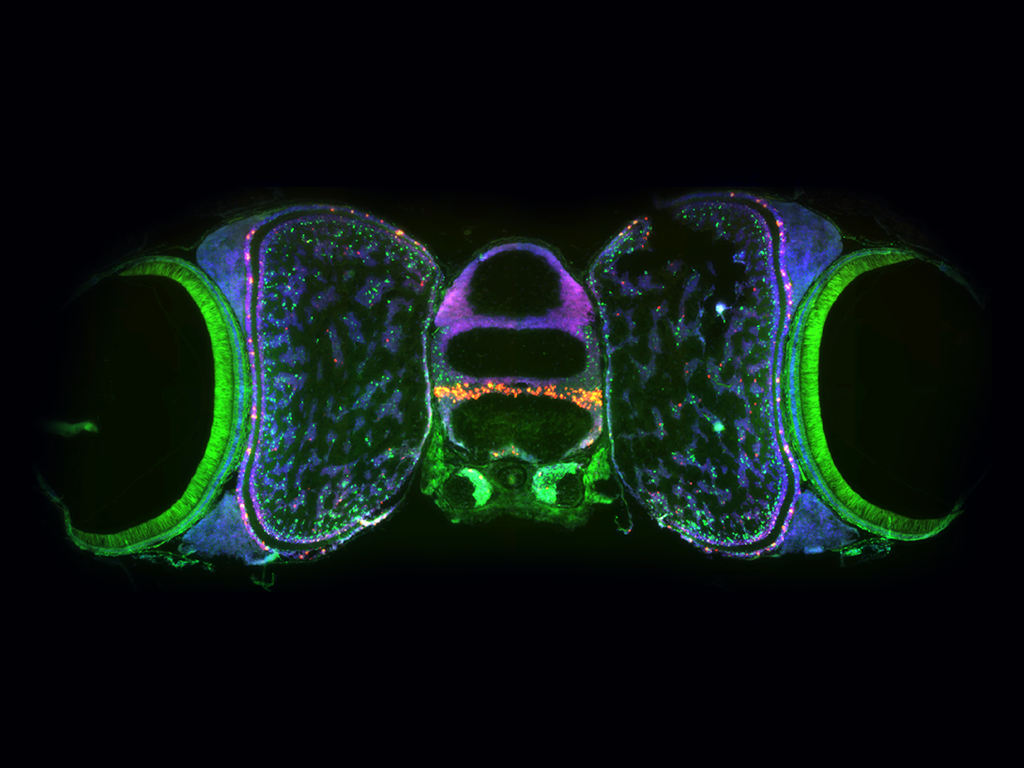
Octopuses are among the most enigmatic creatures on the planet—eight flexible arms covered in suckers, the ability to camouflage into the background, and eyes that look back at us with a noticeable, eerie intelligence. Evolutionary history has separated octopuses and their fellow cephalopods from humans for hundreds of millions of years. As a result, their brains are incredibly different from our own, almost alien-like. Why then are scientists like Cris Niell, professor of biology and neuroscience at the University of Oregon, studying the octopus nervous system to better understand human development and disease?
Neuroscience traditionally focuses on a small number of model organisms like worms, flies, and fish with highly developed genetic tools and community knowledge that facilitate research. However, diversity in model organisms is essential—every animal has unique but limited biological possibilities generated by evolution—a fact scientists at the UO are known for embracing. In the 1970s George Striesinger revolutionized developmental biology by demonstrating the power of the zebrafish as a model organism. Today more than 1,500 labs all over the world use zebrafish to answer questions that eluded researchers using other models.
Not So Different After All
Niell and his colleagues are continuing this legacy by pioneering the study of the octopus visual system. However, while the zebrafish is powerful in part for its similarity to humans, the octopus brain is particularly valuable for its otherness. By choosing to study the octopus, the Niell lab is learning what principles of the visual system are shared and what differences mean for sensation and processing.
Niell’s team first used molecular biology methods to create an atlas of the octopus brain, categorizing and mapping neuron types within the visual system. Next, they developed new microscopy methods to look directly into the octopus brain and observe cells firing in response to different visual patterns in real-time. They learned that even though the hardware of the octopus brain is radically different, it may be using some of the same image processing algorithms to analyze the scene.
One exciting translation of this new knowledge is in developing novel architectures for AI. Many AI models, especially for vision, are based on neural networks inspired by the mammalian brain. The Niell lab is designing visual AI systems based on the alien technology of the octopus brain.
This work may also provide insights for human health and disease. The octopus brain continues to grow throughout its lifetime, adding new neurons in a way humans can’t. The Niell lab is developing ways to watch how these newly born neurons wire into the brain. Understanding how this process works in the octopus could inform approaches to introducing neurons after traumatic brain injury, stroke, or other disease to repair damage.
The Niell lab’s work exploring and classifying the components of a new visual system, building tailored microscope systems for active imaging of the brain, and applying these findings to AI and regenerative medicine, demonstrates how fearlessly embracing neurodiversity can rapidly push neuroscience research forward.