
May 2022
RAP IACUC Project
The RAP IACUC project team continues to focus on the final setups and training preparations for the IACUC module implementation this summer.
RAP COI Project
The RAP COI project team continues to refine the proposed business process changes.
The system requirements identified during the onboarding phase are being clarified in preparation for the development phase in July.
If you have any questions about either project, please email rapinfo@uoregon.edu.
April 2022
COI Project
The COI project team completed a four-week onboarding process with the vendor to identify system requirements and proposed business process changes. Over the next few months, the project team will review the system requirements and proposed business process changes with stakeholders in the research community for feedback.
If you have any questions about the COI project, please email rapinfo@uoregon.edu.
March 2022
IACUC Project
The IACUC the project team continues to focus their efforts on training preparation and go-live readiness for the system launch this summer.
The Next RAP Project: RAP COI
Last week, the Office of the Vice President for Research and Innovation (OVPRI) kicked off the implementation for a new conflict of interests (COI) tool that will support the Financial Conflict of Interest in Research policy and the Conflict of Interest, Conflict of Commitment, and Outside Activities policy. This new tool is scheduled to go-live in late 2022.
Over the next couple of weeks, the project team will be meeting with the vendor to review the COI system and identify system configurations and/or business process changes that may be required for system implementation.
The project team will provide monthly updates about the progress of the COI tool implementation. If you have any additional questions, please email rapinfo@uoregon.edu.
February 2022
User testing completed on January 28. The project team reviewed the test results and feedback from users which resulted in some minor changes to the system.
Over the next few months, the project team will focus their efforts on training preparation and go-live readiness for the system launch this summer.
January 2022
Over the past few weeks, the project team has been actively planning and preparing for user testing. User testing is set to begin today, January 18, and run through January 28.
User testing is being completed by a handful of animal researchers and IACUC staff.
The goal of user testing is to verify that the system operates as expected before moving the system into the live environment. Its purpose is to validate the end-to-end business flow by walking through real-world scenarios, identify any issues that need to be corrected prior to go-live, and help inform training.
Once user testing is complete, the project team will shift its focus to preparing for training and go-live this summer.
December 2021
After careful consideration by OVPRI leadership and the project team, the IACUC project timeline has been extended and we plan to go-live with the new IACUC tool in late summer 2022. An exact date will be communicated next year.
In adjusting the timing, we were motivated to:
- ensure investigators a smooth roll-out and transition from the current system (eAPM),
- allow the Animal Welfare Services team more time to develop and build adequate support resources for the new tool, and
- provide the team time to prepare for the AAALAC International accreditation renewal process which will take place in the first half of 2022.
What does this mean for investigators?
Protocol submissions, renewals, and amendments will continue to take place in eAPM through the first half of 2022. This will allow the project team to migrate more information and consolidate a library of standard procedures.
Investigators and their teams will need to fully populate and validate protocols in the new system after go-live and prior to any protocol amendments or modifications.
What’s Next?
The project team will continue working on the project and will begin user testing in mid- to late-January 2022. More precise timing and information about the transition will be available in the coming months.
October 2021
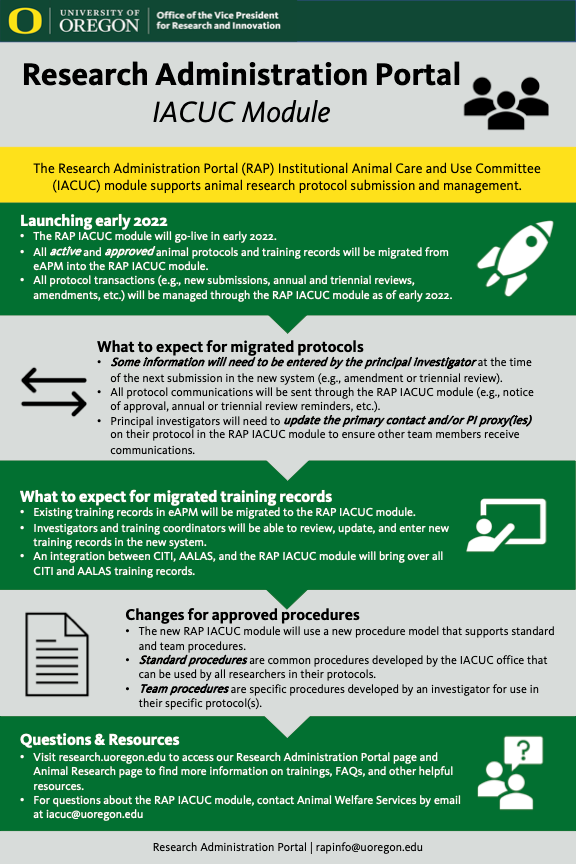
The project team has developed a one-page resource summarizing the changes that will come with the IACUC module and what you can expect.
October 2021
The project team continues to work with the vendor on system configuration and development. This work will continue over the next month.
Once system configuration and development are completed, the team will begin user acceptance testing (UAT). User acceptance testing is a type of testing that is performed by end users to verify that the system operates as expected before moving the system into the production environment. UAT is an important step to perform before rolling out new systems. Its purpose is to validate the end-to-end business flow by walking through real-world scenarios, identify any issues that need to be corrected prior to go-live, and help inform training.
UAT is scheduled to begin in late-November/early-December. If you are interested in participating in user testing, email your interest to rapinfo@uoregon.edu.
Lastly, to help keep the community informed about this project and the changes the new system will introduce, the project team has updated the Animal Research page on the research website with two new pages:
September 2021
The final system requirements have been approved. The project team has started working with the vendor on an iterative system development and configuration process. This is expected to continue over the next few months.
A project update communication was sent to the IACUC community on 8/27 from Jim Slattery, Associate Vice President for Research Operations. This communication included a link to a webpage providing users with a sneak peak of the new IACUC module.
If you would like to receive monthly updates about this effort, please subscribe to the following email list: rap-iacuc-module@lists.uoregon.edu, or click to subscribe.
August 2021
The project team is still in the process of finalizing system requirements.
For the past couple of weeks, the team has been working with the vendor on a series of design sessions to finalize requirements. The final system requirements will be reviewed and approved by the Vice President for Research and Innovation based upon the recommendation of the project champions and team. After that, the team will begin working with the vendor on an iterative system development and configuration process. This process will begin shortly and will take a couple months to complete.